
Policy Brief
The smart green switch: a digital framework for equitable urban greening in the euro-mediterranean region

Abstract
This Policy Brief examines how urban greening in the Euro-Mediterranean region continues to be shaped by structural inequities and weak planning frameworks, where low-income neighbourhoods and cities bear the brunt of heat, pollution, and limited access to green space. While municipalities invest in tree-planting and green infrastructure, many initiatives remain reactive, driven by land availability rather than environmental or social need, and often exclude community input.
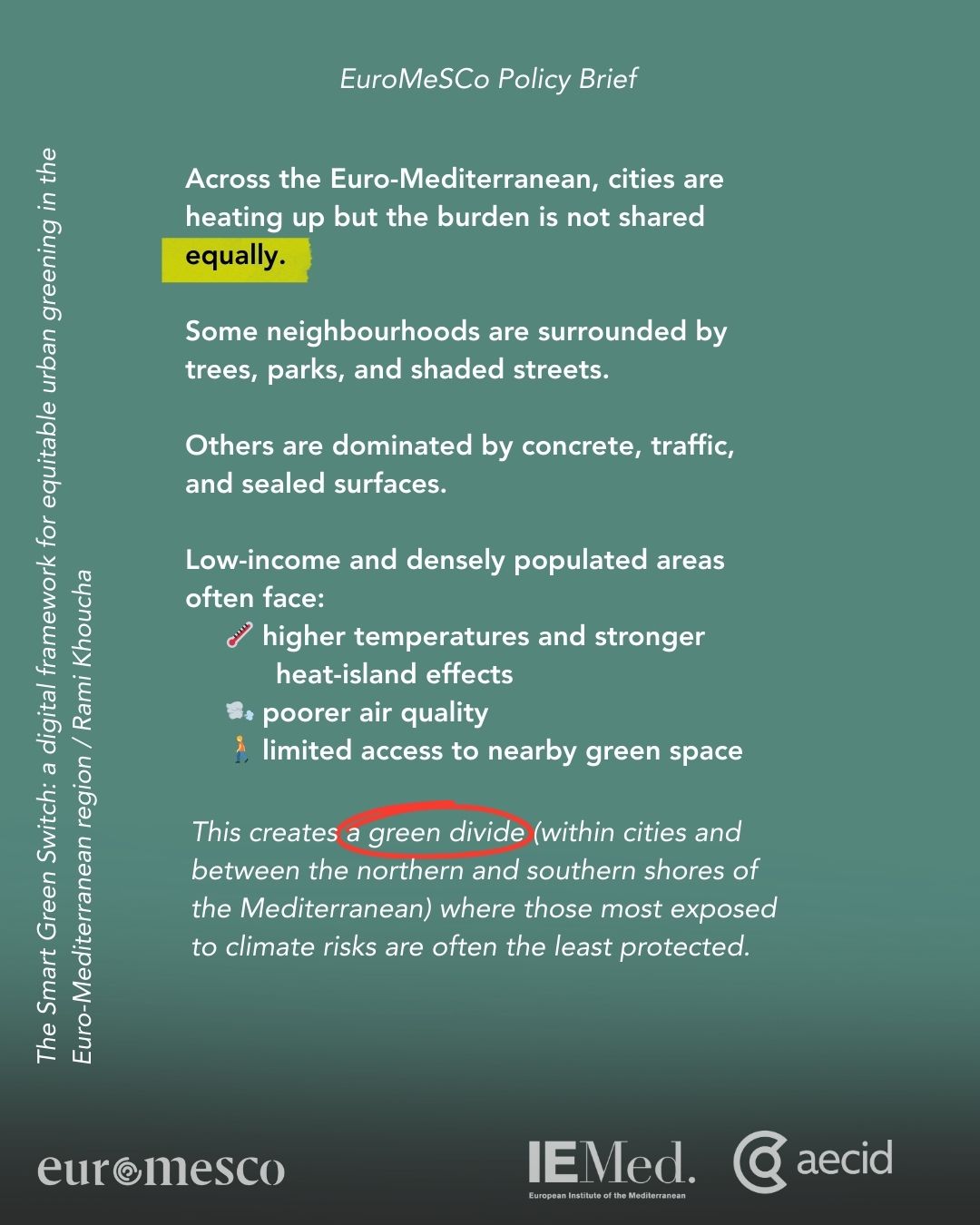
The analysis shows that current greening strategies fall short of delivering cooling, air-quality, and equity outcomes. Data deficits, limited institutional capacity, and fragmented responsibilities prevent cities from identifying heat hotspots, modelling environmental impact, or prioritising areas of greatest vulnerability. At the same time, top-down planning erodes public trust, leading to underused spaces, poor maintenance, and missed opportunities for long-term resilience.
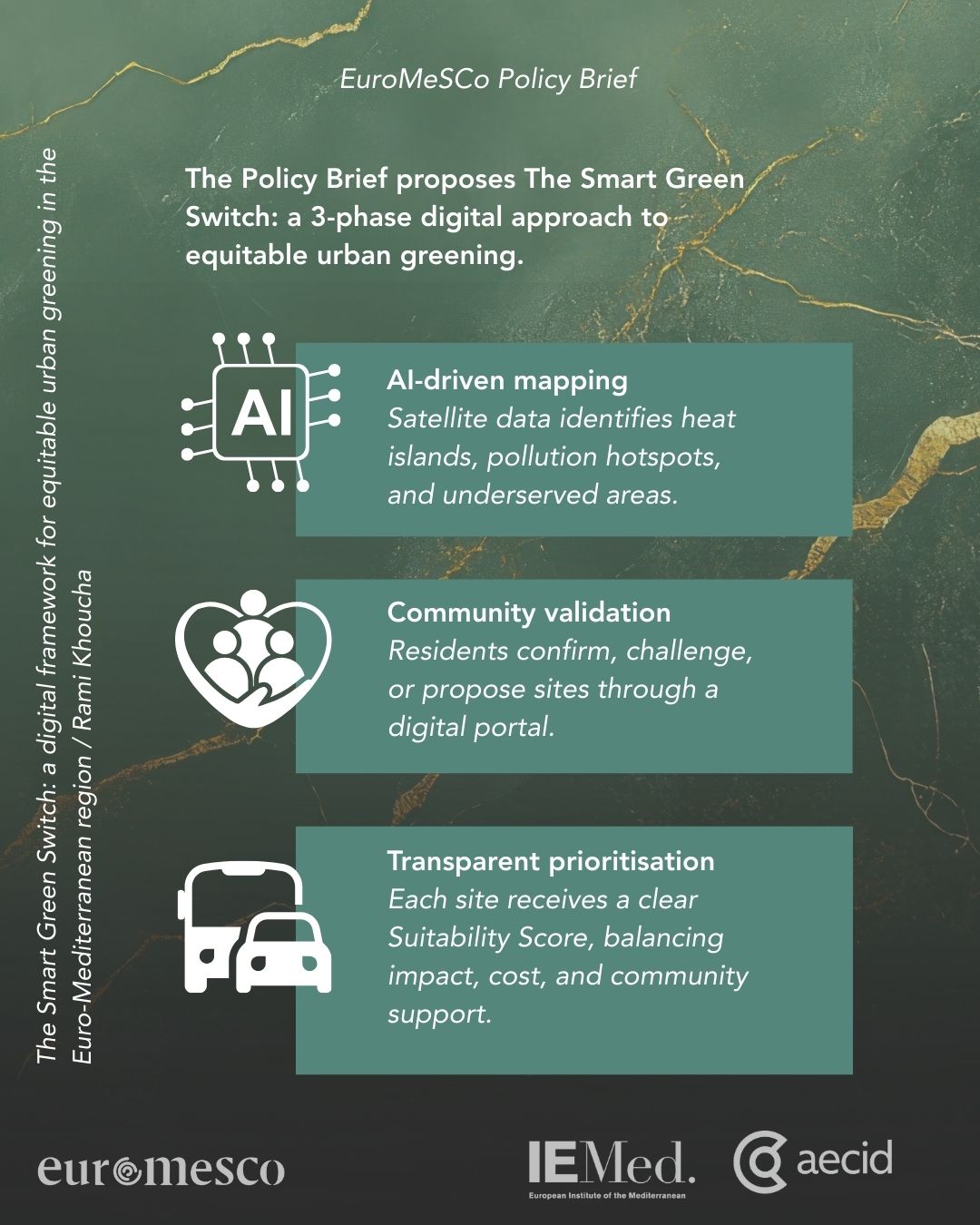
To address these gaps, the Brief proposes the Smart Green Switch: a three-phase digital framework that combines AI-driven spatial mapping, community validation through a digital engagement portal, and a transparent, adjustable decision-support system. Using openly available satellite data alongside local knowledge, the framework assigns a clear suitability score to potential planting sites, allowing municipalities to balance ecological impact, budget constraints, and community priorities in a transparent and accountable way.
The Brief calls for a strategic shift from symbolic tree-planting to targeted, data-driven urban greening, grounded in equity, transparency, and participation. By aligning digital tools with community engagement, it shows how greening can become a powerful instrument for climate adaptation, public health, and social cohesion across the Mediterranean.
It recommends:
• Integrating digital community engagement into EU urban greening frameworks, including the Green City Accord
• Funding an open-source toolkit to support AI-based mapping and participatory planning, particularly in data-scarce cities
• Establishing cross-departmental “Green Equity Teams” at municipal level
• Launching EU–MENA pilot projects to build capacity and demonstrate scalable impact
• Linking climate and urban-development funding to transparent, equity-based greening outcomes