Policy Brief
The security and reconstruction nexus in Syria: lessons for the Pact for the Mediterranean

Abstract
As the European Union moves to re-engage with Syria after a decade-long freeze in cooperation, the country’s reconstruction is becoming a central issue. In this context, the EU’s renewed political and economic engagement with Damascus; including the proposed resumption of the EU-Syria Cooperation Agreement and Syria’s prospective participation in the Pact for the Mediterranean, signals a major shift in European policy towards the country.
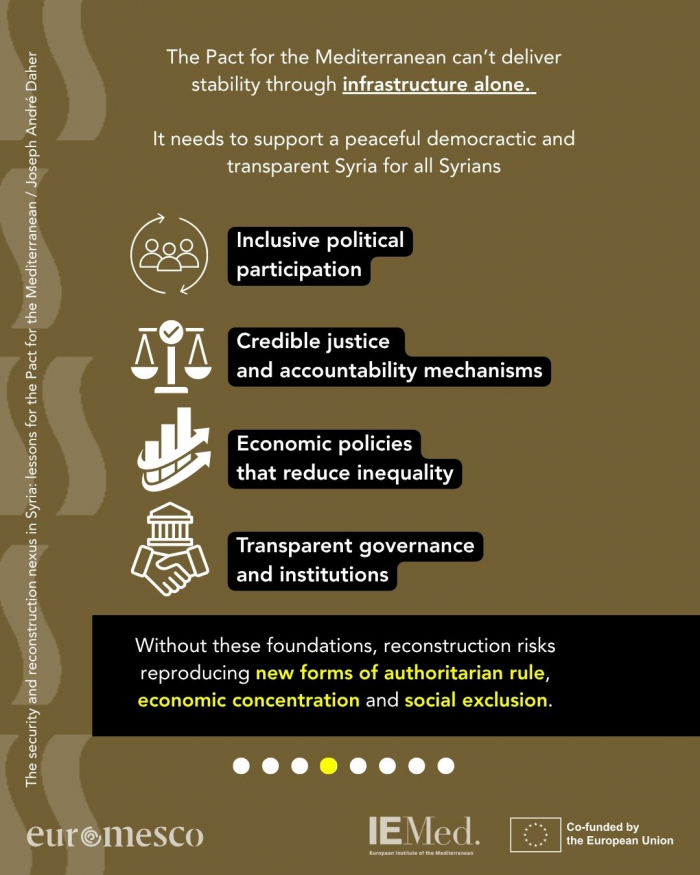
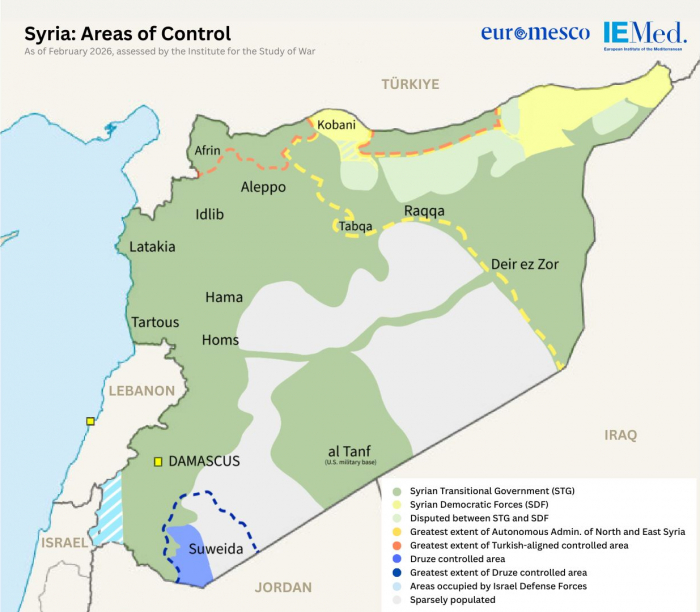
Focusing on the Pact’s third pillar on peace, security and migration management, the brief argues that reconstruction efforts centred primarily on military stabilisation, centralised governance and elite-driven economic liberalisation risk deepening sectarian tensions, political fragmentation and socio-economic exclusion. It analyses the policies pursued by Syria’s new authorities, including military offensives against rival regions, the concentration of institutional and economic power around the Presidency and Hay’at Tahrir al-Sham (HTS), restrictions on political participation, and austerity-driven economic reforms.
The analysis highlights how ongoing human rights violations, weak accountability mechanisms, arbitrary economic restructuring and the consolidation of business networks linked to the ruling elite undermine prospects for sustainable recovery and inclusive governance. While Syria has seen renewed diplomatic engagement, sanctions relief and growing foreign investment interest, the country continues to face severe humanitarian, economic and social challenges, with widespread poverty, displacement and food insecurity constraining long-term stability.
The brief concludes that a durable reconstruction process requires a broader “human security” approach rooted in democratic participation, transitional justice, inclusive economic development and decentralised governance. It recommends that the EU ties financial support and reconstruction assistance to clear governance benchmarks, strengthens support for civil society and local actors, promotes accountability mechanisms, and ensures that reconstruction efforts benefit wider segments of Syrian society rather than reinforcing new forms of authoritarianism and elite capture.