
Policy Study
Aligning or fragmenting? The future of Euro-Mediterranean migration governance under the EU Pact(s)





Abstract
The Euro-Mediterranean region is entering a critical phase in the governance of migration and mobility. In recent years, migration has become a central issue influencing political debates, regional cooperation, and institutional agendas in both European and Southern Mediterranean contexts. The adoption of the EU Pact on Migration and Asylum, alongside the Pact for the Mediterranean, represents a renewed effort by the European Union (EU) and its partners to reorganise migration governance within a broader framework of regional cooperation. The Pact seeks to strengthen border management, reform asylum procedures, expand legal mobility pathways, respond to labour-market demands in ageing European societies, and deepen development cooperation and regional stability.
Given this context, a central question is whether the emerging Pact(s) architecture can effectively align these competing dimensions or whether it risks perpetuating existing fragmentation within the regional governance landscape. Although the new frameworks emphasise partnership, shared responsibility and policy coordination, their implementation may continue to generate tensions between security imperatives, labour mobility needs, and broader demographic transformations affecting both sides of the Mediterranean.
This study examines the debate through a collaborative analytical framework that synthesises complementary perspectives organised around several thematic pillars. By integrating insights from migration policy analysis, demographic trends, labour-market dynamics, and regional cooperation mechanisms, the analysis assesses whether the current Pact(s) architecture fosters coherent, sustainable, and mutually beneficial governance in the Euro-Mediterranean region.
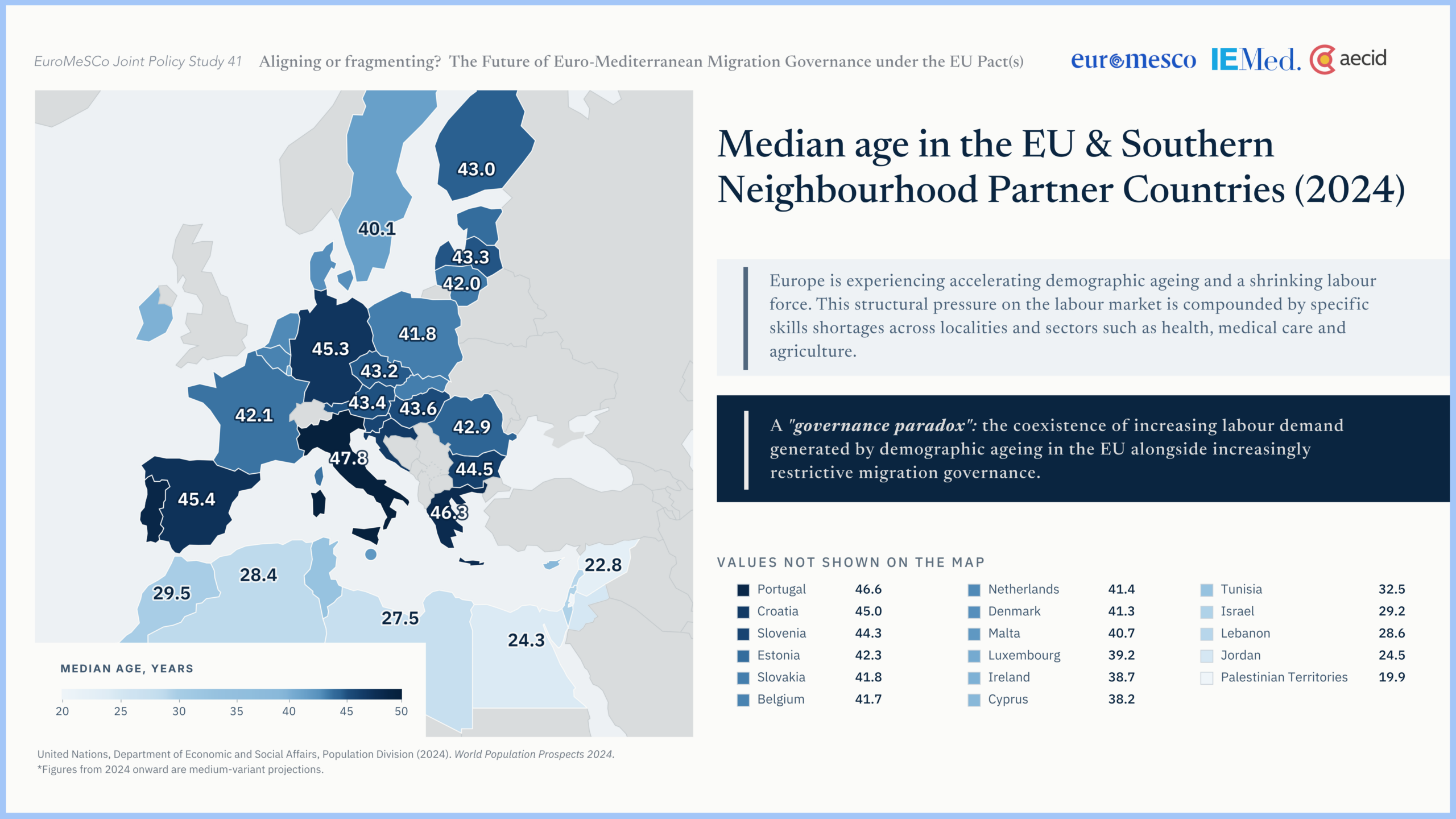
Chapter 1 frames the underlying problem as a “governance paradox”: the coexistence of growing labour demand, driven by Europe’s demographic ageing, alongside increasingly restrictive, security-focused migration governance. Building four scenarios for 2025–2035, from a pragmatic “Integrated Selective Governance” to a fully restrictive “Transactional Externalised Security Regime”, the chapter argues that which path the region takes will depend on political choices, not technical capacity.
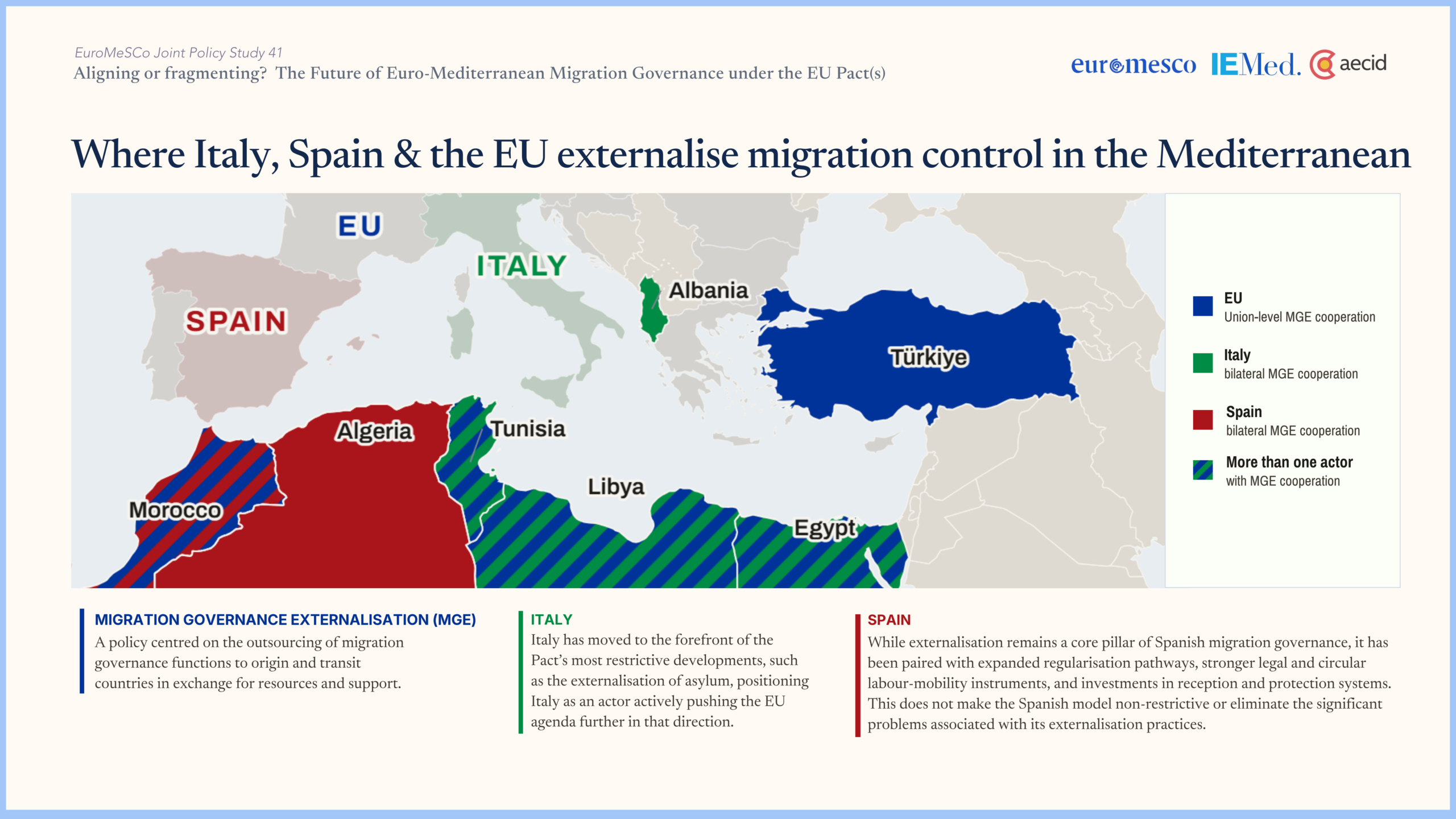
Chapter 2 answers this by comparing Italy and Spain, the EU’s two main frontline implementers of externalisation. Since the 1990s, both countries have relied on cooperation with origin and transit states —border control, financial support, development cooperation, diplomatic concessions and selective mobility— as core governance tools. Partner geographies differ (Libya, Tunisia and Niger for Italy; Morocco, Mauritania and Senegal for Spain), but “the underlying logic remains largely the same.” Under the Pact, Italy has moved to the forefront of the most restrictive developments, notably its 2023 protocol with Albania to process asylum claims on Albanian soil. Spain, while still centred on externalisation, has combined it with expanded regularisation, legal and circular mobility channels and reinforced reception capacity.
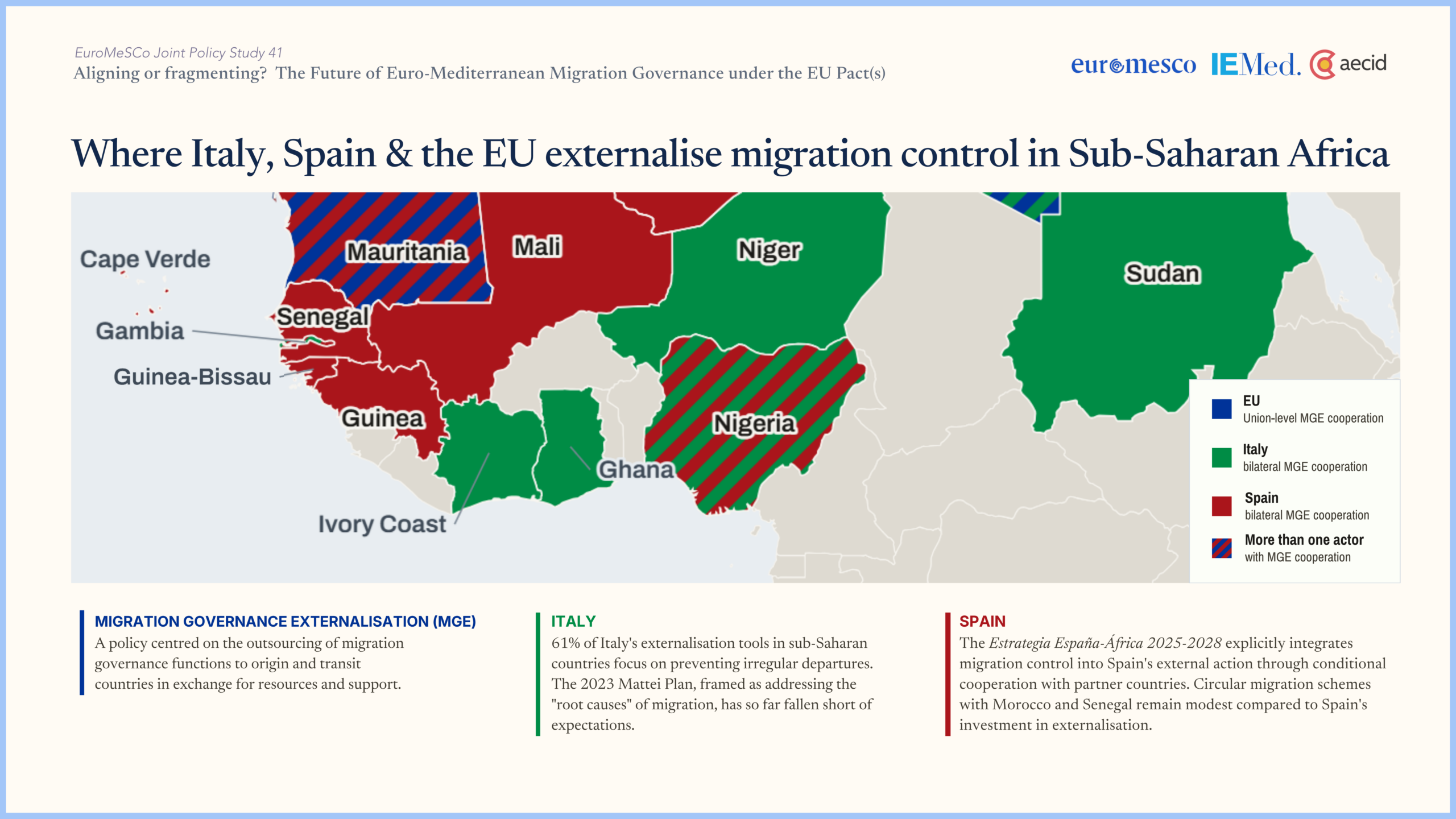
That same Chapter 2 shows externalisation reaching beyond the Mediterranean’s immediate south. From 2016 onward, Italy extended bilateral cooperation into the Sahel and West Africa —Niger, Nigeria, Sudan, Ghana, Gambia, Ivory Coast— with 61% of the externalisation tools deployed in sub-Saharan countries explicitly aimed at preventing irregular departures. Spain’s own Africa Plans (2006–2023) institutionalised a parallel logic along the West African route, linking migration containment in Senegal, Mali, Mauritania, Gambia, Guinea and Cape Verde to development aid, foreign investment and trade facilitation.
Chapter 3 turns to the other side of this equation: legal mobility. Examining the EU–Maghreb Talent Partnerships with Morocco, Tunisia and Egypt, it asks whether these frameworks offer a genuine “win-win,” rights-based approach, or simply formalise labour precarity. Without recognising workers as agents, aligning mutually beneficial sectors, and decoupling mobility from strict return and readmission conditions, the chapter warns these partnerships risk producing brain drain or brain waste rather than sustainable brain circulation.
Underneath both the externalisation logic of Chapter 2 and the labour-mobility logic of Chapter 3 lies the structural driver Chapter 4 puts at the centre of the debate: demographic asymmetry.
Europe is experiencing accelerating demographic ageing, a shrinking labour force and rising dependency ratios. The Southern and Eastern Mediterranean, by contrast, still holds a comparatively young and growing population. Chapter 4 describes the resulting gap as a “demographic dividend”: a structural complementarity between an ageing North and a younger South.
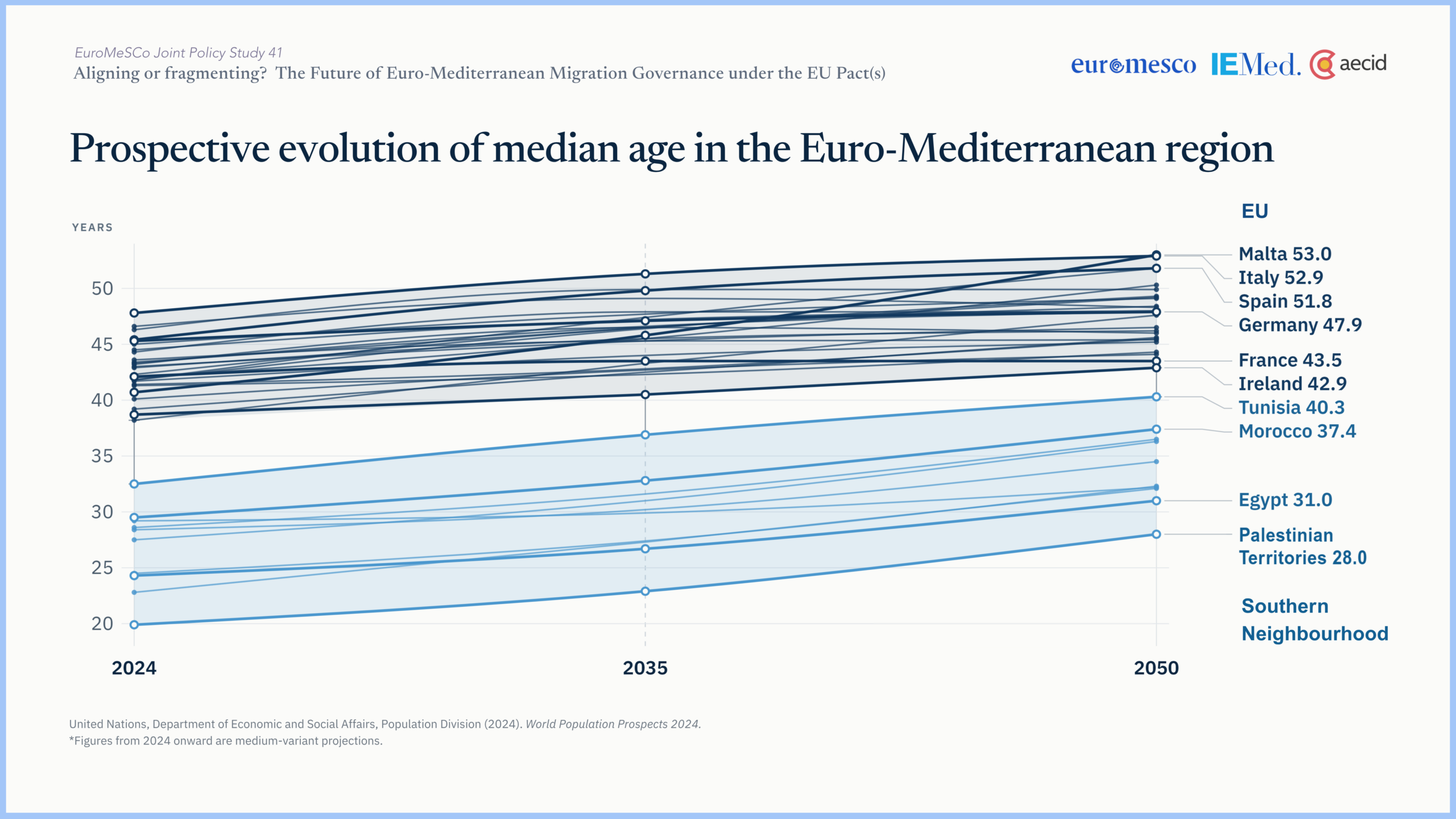
Chapter 4 is careful to note this complementarity is a “window of opportunity” estimated to hold only until around 2035, which does not translate automatically into cooperation. Political legitimacy, anti-immigration sentiment and sovereignty concerns determine whether demographic complementarity is converted into sustainable mobility frameworks, or is instead addressed —as the Pacts currently do— primarily as a labour-shortage and welfare-sustainability problem, managed through restrictive, security-driven channels while its costs are externalised to Southern and Eastern neighbours.
Thus, the study asks whether the Pact(s) can still become the coherent, rights-based and mutually beneficial framework they claim to be, or whether they risk institutionalising the very contradictions between security, labour mobility and demographic sustainability they were designed to resolve.